Selling Satellite
Understanding the advantages and finding ideal use cases.
A lot has changed. Not so long-ago, say prior to 2015, satellite services were slow, expensive and had a latency problem. Today, a lot has changed, with customers everywhere eagerly awaiting being able to replace almost all other connectivity solutions with OneWeb, Kuiper, Starlink and other LEO options.
While the new LEO and GEO satellite services have undoubtedly moved the paradigm in terms of what satellite connectivity can achieve, should they be used to replace all other options? Let’s discuss.
Introduction
While data speeds have multiplied, cost points have dropped and professional installations have evolved into plug-&-play DIY tasks, some fundamentals have not changed. The total available capacity of a satellite constellation over a region is still much less than what can be achieved with terrestrial fibre networks, and fibre service cost points are still much lower than those of LEO services.
Then again, fibre is a fixed infrastructure technology deployed mostly in a point-to-point network topology with significant capex budget, while satellite is a “broadcast-to-many” type technology that can be rapidly deployed at a nominal cost per site. Actually, the capex spend for the new LEO satellite services is provided by the global satellite operators, while local markets can directly benefit through immediate go-to-market advantages.
From this perspective, it is clear satellite is not competing with fibre, microwave or LTE connectivity – it is instead a very different type of connectivity solution that offers very different advantages and challenges in different use cases.
“Matrix for the Basics”
It is always easier to start from a clear understanding of the basic principles involved, and then work from there. In this case we have three aspects or variables to consider i.e., primary or back-up services; single or network sites; and high or low data usage applications.
Leading satellite connectivity solutions such as Twoobii Smart Satellite Services are an ideal option for use as a primary service for a network of low data usage sites, that require high uptime, such as ATM terminals, or as a primary service for specific “off-grid” sites that are not connected to fibre networks, such as lodges or industrial campuses.
Because satellite services are not dependent on any terrestrial tower or power, they offer a very high availability (typically 99.95%, which is equivalent to just 43 seconds of downtime per day), and are therefore perfect for back-up services in SD-WAN networks, or for single sites connected with fibre circuits. When the strength of satellite technology is compounded by the “pay-as-you-go” commercial model offered for Twoobii services, it makes satellite the ideal option to deliver trusted network services to almost every industry and use case, including branch networks, retail operations, government functions and general industry.
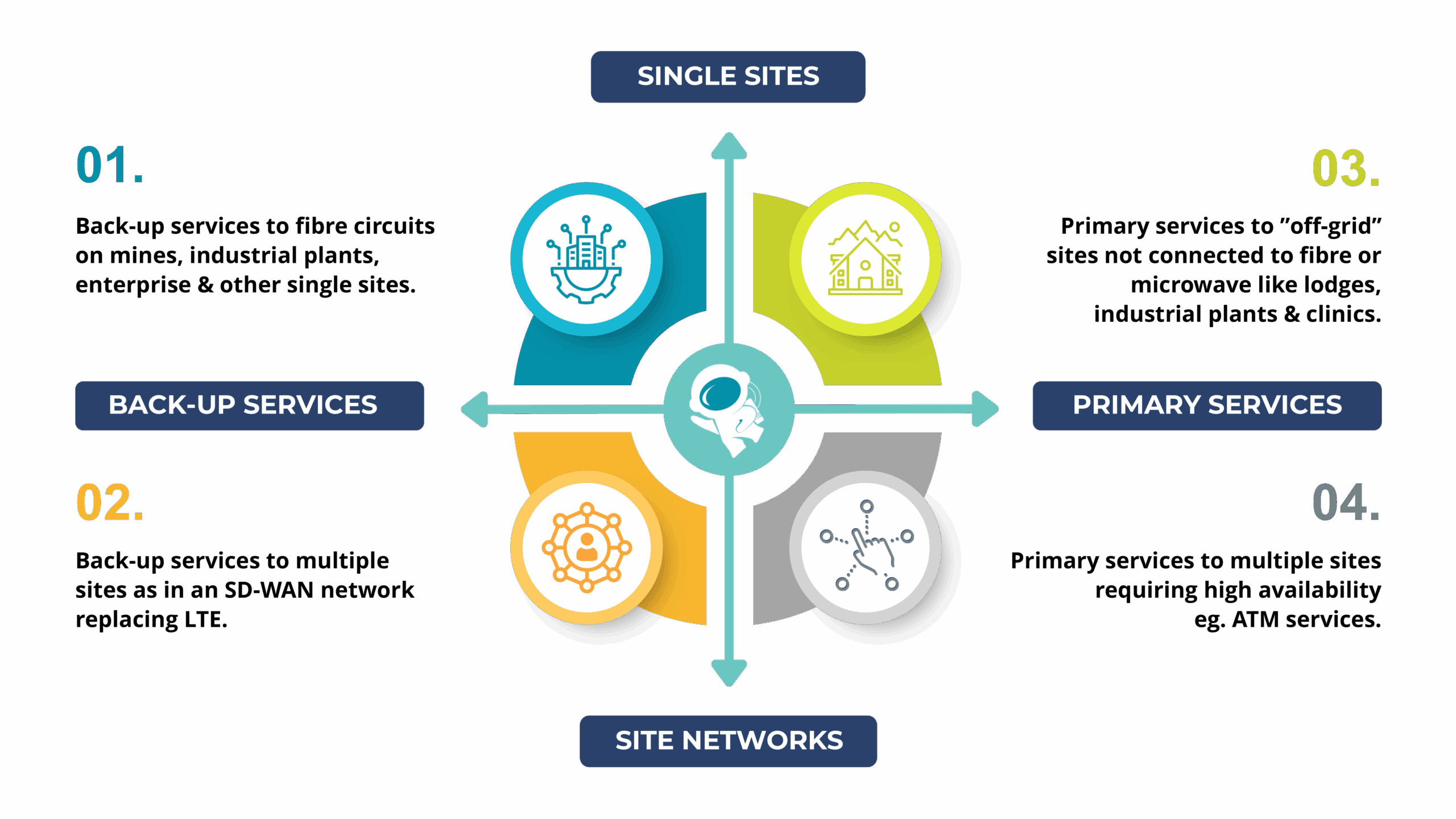
User Applications Schedule
Twoobii Smart Satellite Services can connect single or multiple sites at any location, for primary or back-up services with fixed fee, variable or pay-per-use billing.
The schedule below provides a quick reference guide to use case categories and typical satellite services. It acts as a clear guide to matching different use cases with the strengths of satellite services, in the quest to implement sustainable user solutions.
It also provides clarity on use cases not suited for satellite services, such as primary services to a large network of sites. This is because the fundamental cost points of satellite services are still higher than those for fibre and therefore, where fibre services are available, they should still be used as the primary connectivity option.
Also, while the available network capacity of the new satellite networks is much greater than it used to be, it should still be seen as limited and will quickly lead to service congestion and service degradation in areas with concentrated, high usage demand. (This is typically why Starlink services reached network saturation in large cities such as Lagos and Nairobi).
| Client Needs | Why is Twoobii a perfect match? |
| Primary services to “off-grid” locations not connected with fibre. | • Lodges; Mining operations; Clinics; Schools • Available anywhere in Africa, rapid deployment with full on-site support. • Up to 75Mbps uncapped services with seamless integration with customer core networks. • Fixed fee, no variable billing and low-latency and compliant with all corporate applications |
| Primary services to networks demanding high availability. | • ATM networks; Point-of-sale retail trading; Industrial monitoring; • Most reliable technology option at 99.95% assured network uptime. • No dependency on local infrastructure or cabled networks. • Usage-based billing for the most cost-effective options. |
| Back-up services in SD-WAN networks replacement for LTE. | • Retail networks; Enterprise branch locations; • Up to 75Mbps anywhere easy to install, no dependency on towers or other infrastructure. • 99.95% uptime ensures very reliable user network connectivity. • Cost effective with “pay-per-use” billing models and SD-WAN proven. |
| Back-up services for high-speed fibre circuits | • Mining sites; Telco infrastructure; Hospitality; Enterprise • Back-up services for point-to-point fibre circuits to industrial, enterprise or telco sites. • Very high uptime possible, rapid implementation, no infrastructure required. • Includes equipment and onsite support. |
Figure 2: User Application Schedule
Financial Considerations
Within the correct context and considering the attributes of satellite connectivity services, we can optimally match use cases with the required satellite services and deliver quantified commercial and performance value to customers.
For example, the Twoobii-OneWeb primary service for an “off-grid” lodge provides an uncapped 75Mbps/15Mbps service with a priority data bundle of 750GB at a cost of R19,691 per month. Similarly, the primary service to ATM sites for a financial customer can provide 10Mbps/2Mbps services at fixed cost of R953 per month.
To meet back-up requirements, the Twoobii-GEO service can be paired with fibre circuits in an SD-WAN topology to provide 80Mbps/20Mbps back-up service at a pay-per-use model based on a price point of 2c/MB. Alternatively, the Twoobii-OneWeb service can provide elevated availability and operational uptime assurances to a remote mine or industrial location at a basic charge of R4,052, plus an additional pay-per-use charge.
Conclusions
Yes, the emerging Low-Earth Orbit (LEO) global satellite industry and recent innovations in the Geostationary (GEO) satellite industry have resulted in a paradigm shift on satellite connectivity services. Today’s satellite services are no longer bedevilled by perceptions of low speed, high cost, and significant latency problems. When matched to the correct end user applications, the latest services – such as Twoobii Smart Satellite Services – offer real value in terms of cost and performance to end users across multiple sectors.
Interested in Twoobii Smart Satellite Services, contact us on: enquiries@qkon.com
Article supplied by:
Dr Dawie de Wet (Pr. Eng. M.Sc. Eng.) – Group CEO of Q-KON and their African supported satellite broadband service, Twoobii. With over 30 years’ experience in designing, engineering, developing and implementing wireless, microwave and satellite communication systems in Africa, Dawie continues to focus on developing telco solutions that meet the user requirements of emerging markets through the deployment of world-class technology.