
Selling Satellite
Satellite is not a competing technology – it is a complementary technology.
The recent fundamental changes and large-scale growth in planned Geostationary (GEO) and Low Earth Orbit (LEO) satellite constellations have led to renewed interest in satellite networks as solutions for enterprise, government and consumer connectivity. It is therefore only natural to compare satellite to fibre, microwave and LTE in order to determine the best connectivity technology solution in any given scenario.
This outline will show that satellite is essentially a different technology, rather than a direct competitor to other networks.
Introduction
For context, we are discussing satellite technology and services in a broad sense, and that definition includes both LEO and GEO services for the purposes of this article. We will refer to Q-KON’s Twoobii Smart Satellite Services as needed, to illustrate specific advantages or use cases.
With the significant reductions in the cost of satellite connectivity and the equally significant increases in satellite data speeds, our premise is that satellite services are now able to meet multiple business requirements. Then from this perspective, the focus should be on understanding the different characteristics and performance dynamics of modern satellite services versus the other available technologies.
Satellite is different
From a network architecture perspective, fibre services and microwave links are essentially point-to-point services. That is, a fibre cable is routed along a very specific physical path from the end-user premises to the network access point, thereby forming a point-to-point fixed circuit between the two end points of the fibre cable.
Microwave links are deployed in a similar manner, with the exception of networks that allow point-to-multipoint circuits (which are really just multiple point-to-point links). When services are connected in this way, there are various implications to be considered, such as the fact that services cannot readily be provided to nearby locations; or that services can only be delivered along a specific route or to a specific area; or that compatible network infrastructure is required before service on a fibre cable route or in a microwave network, can be provided.
LTE or 3G services, in contrast, are delivered to customer end-points connected to countrywide mobile cellular networks. For LTE services to operate, it is a prerequisite that the mobile network infrastructure must be available in a particular region. In this way, LTE services can also be considered as a type of point-to-multipoint service, with the towers functioning as multiple central points connecting to remote end-user LTE devices. Furthermore, the quality of LTE services is determined by the specific performance of the mobile network in any given area, leading to services being prone to terrestrial risks such as cable theft and tower vandalism.
Satellite is interesting
Satellite services offer the capacity, quality and high availability of a fibre circuit, combined with the flexibility and ease of deployment of an LTE network. This makes satellite a “best of both worlds” option. In other words, end-users can readily be connected anywhere simply by installing a terminal which will connect the user to the network core in a similar manner to fibre. The service can then be configured as a single point-to-point-type circuit between the end-user and the network, or it can be configured to connect hundreds of end-user sites to the network in a point-to-multi point scenario, similar to an LTE set-up. End-user sites can be in close proximity to each other or at widely distributed locations.
Satellite networks can therefore provide the data speeds and performance advantages of fixed fibre point-to-point circuits, plus the flexibility and deployment advantages of LTE networks.
Satellite vs. the rest
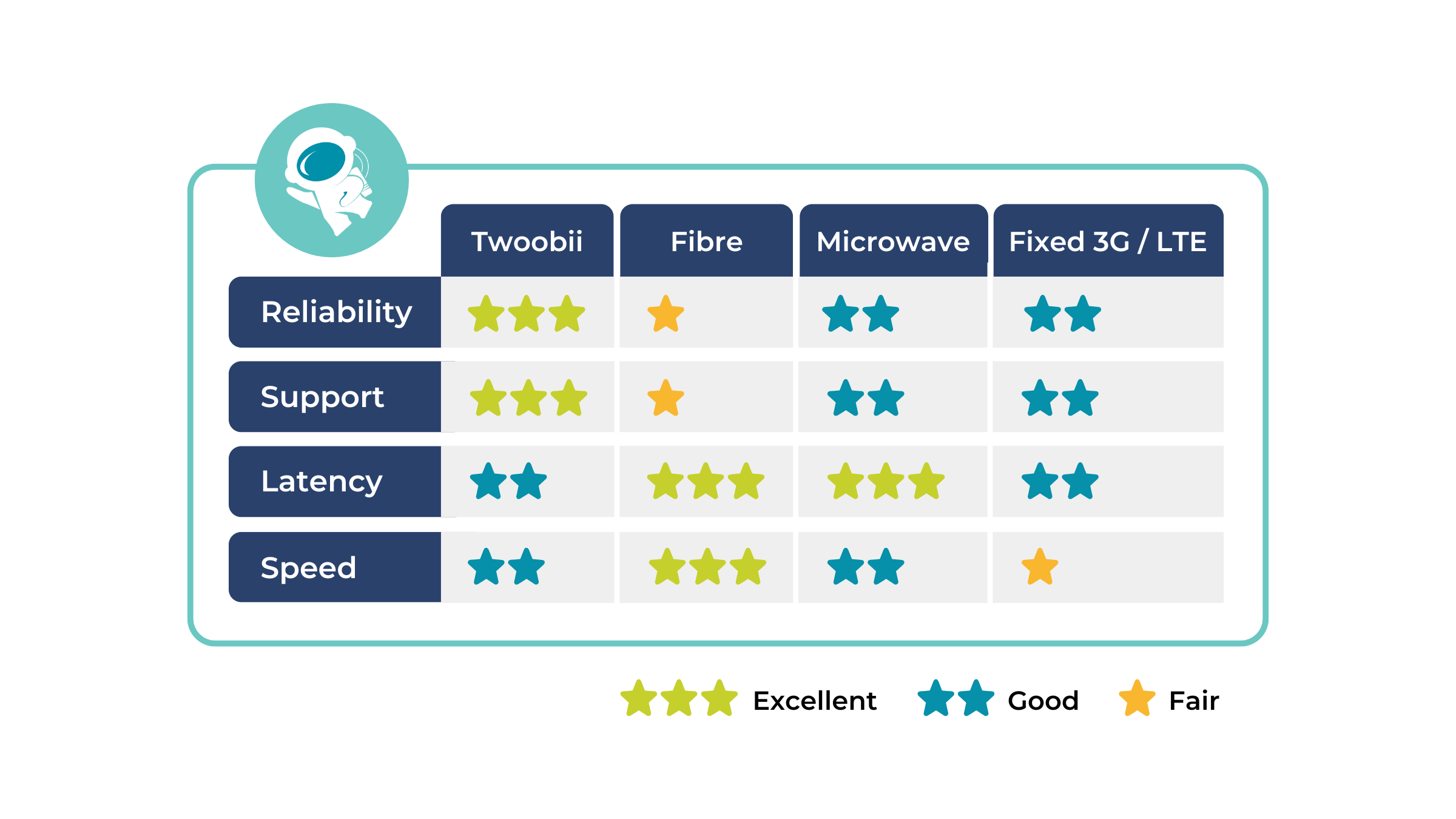
From this perspective, we can devise a table that compares the relative attributes position of the different network technologies.
Reliability
| Satellite networks not affected by theft, vandalism or network failures, making satellite by far the most reliable option. For example, Twoobii network uptime has exceeded 99.95% over the past three years. Fibre cables are prone to physical damage that often affects both the primary and backup links, while microwave and LTE networks rely on terrestrial tower infrastructure that is vulnerable to vandalism and theft.
|
Support | Satellite user terminals are very reliable, with a lower than 5% failure rate per annum. Such a low failure rate means that excellent onsite support can be provided; for example, the Twoobii network is supported by a next-day, all-inclusive onsite support service. The nature of fibre cables makes this level of support unfeasible; equally, tower infrastructure damage in microwave/LTE networks cannot be repaired this quickly.
|
Latency | Yes, latency used to be a disadvantage of satellite links, but this has now been resolved by LEO networks offering sub-50msec link latencies and GEO network technologies that include latency mitigation algorithms.
|
Speed | Fibre will always be the preferred medium for high-speed, high-volume primary links. Yet where fibre is not available, the typical 100Mbps speed currently offered by GEO and LEO services makes these services very attractive as primary connectivity options in “off-grid” locations, or as back-up services.
|
Conclusions
Recent innovations and the ongoing development of global LEO satellite networks, as well as the introduction of high-capacity GEO satellite services, have effectively eliminated the legacy constraints of speed, cost and latency experienced with the previous generation of satellite services.
Today, satellite services are very much an integrated part of the telecommunications technology landscape, offering quantified advantages in cost and performance when deployed within the right context and application framework.
Interested in Twoobii Smart Satellite Services, contact us today at: enquiries@qkon.com
Article supplied by:
Dr Dawie de Wet (Pr. Eng. M.Sc. Eng.) – Group CEO of Q-KON, a leading satellite engineering company pioneering Smart Satellite Services in Africa, through their flagship service, Twoobii. Q-KON delivers resilient and innovative services by tailoring global satellite technology to the specific needs of the African enterprise landscape. With over 30 years’ of experience in designing, engineering, developing and implementing wireless, microwave and satellite communication systems in Africa, Dawie steers the company’s focus on developing telco solutions that meet the user requirements of emerging markets through the deployment of world-class technology.

